“Twenty-five holes, give or take, and a path you can’t see at first. I ended up looking at the edges before the floor.”
The pit field is the third form taken by the sinkholes of the Vestibule, after “near” and “far.” Ordinary sinkholes are one big sunken platform, whereas this region is a field of small holes, each with a crude platform at the bottom.
How to recognize it
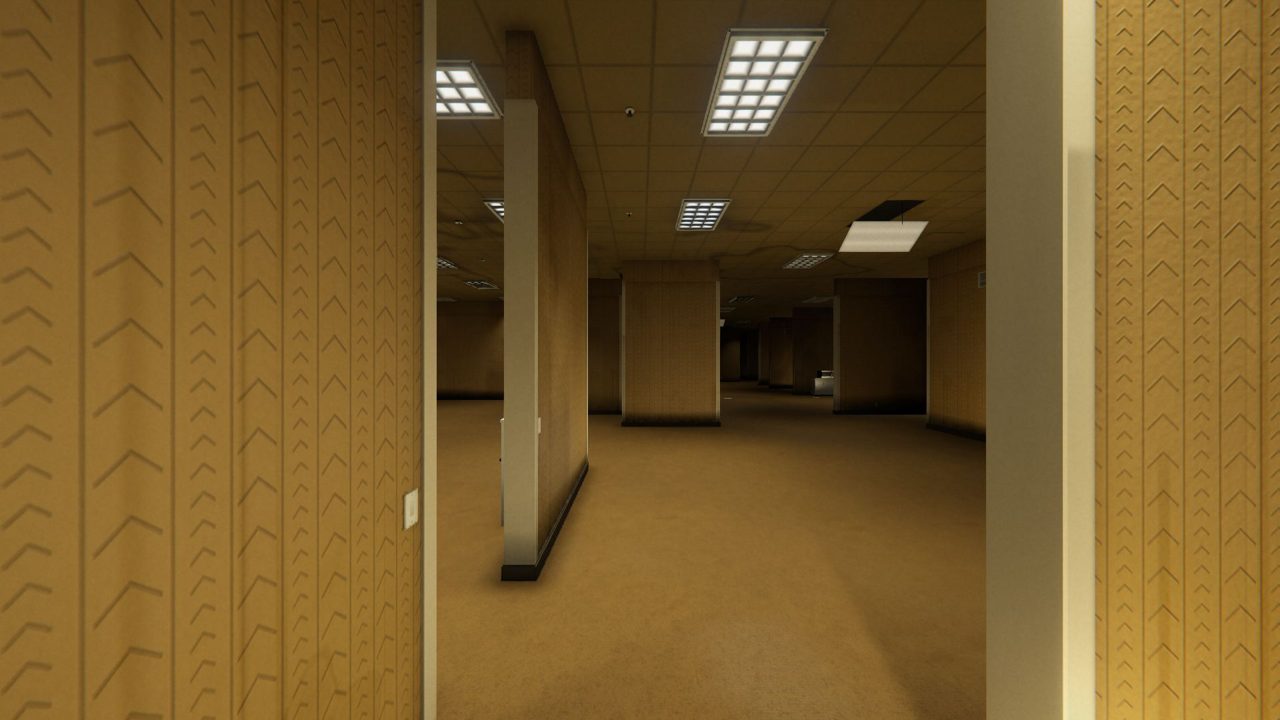
The floor is broken every few meters by a square pit between 1.4 and 2.0 meters on a side. There are about twenty-five per region, laid out in 3.6-meter cells with a margin of three free meters at the edge. The fall ranges between 1.5 and 3 meters. At the bottom of each pit there is a crude box about 90 centimeters on a side, a meter down.
| Data | Value |
|---|---|
| Pits | about 25 per region |
| Side | 1.4 to 2.0 m |
| Fall | 1.5 to 3.0 m |
| Platform | 0.9 × 0.9 m, 1 m down |
| Grid | 3.6 m cells |
The path
No row or column of cells is all pits, and a pit never has all its neighbors also pits. There is always at least one walkable step that crosses the region from one edge to the opposite. It isn’t a straight path, but it exists, and it usually isn’t visible until you have several pits behind you.
How to survive
- Walk slowly. Shallow pits fool you, and three meters of fall is enough to hurt a leg.
- Always look two cells ahead. You can make out the walkable path by the edges that have no hole.
- If you fall, the crude platform catches you but doesn’t get you out. See Wounds and Body Zones and carry a bandage on you.
- Don’t run. The echo of your steps in the field carries far (see Sound That Travels).
What people say
They say that in each pit the platform at the bottom isn’t where you saw it from above. Others say that, from the edge, you sometimes hear something moving down there, and that it isn’t the wind.
See also
Pits, Generation Error Vestibule, Level 1, The Building and the Descent, Stabilization.